A Summary Of The Compound Fertilizer Production Process

When referencing compound fertilizer, this is simply a type of fertilizer which includes 2 or more components. When you have ever used NPK fertilizer, this is amongst the many types that are offered. Of all of the nutrients that happen to be included with these different fertilizers, nitrogen is usually the most essential. Potassium and phosphorus also play a vital role in producing most crops. However, there are so many others which might be useful, based on the crops you might be growing within the period that you are currently doing the planting. The following is an overview of just how the compound fertilizer production process works if you are considering this being a project that for you to do all on your own.

Compound Fertilizer Production Process

This starts off with storage bins that can have an abundance of powdery components. These are the basic nutrients that might be combined together, usually as appellate, that will then decompose in the ground as soon as they are spread to the surface. Production plants are often quite large. It can involve a variety of components. This will include a fertilizer crusher, packing machine, fertilizer mixer, and dryer that may make sure that excess moisture is removed. Furthermore, a rotary screener is frequently used to filter the types of materials. By removing unwanted components, your fertilizer will likely be pure and may produce the best results.
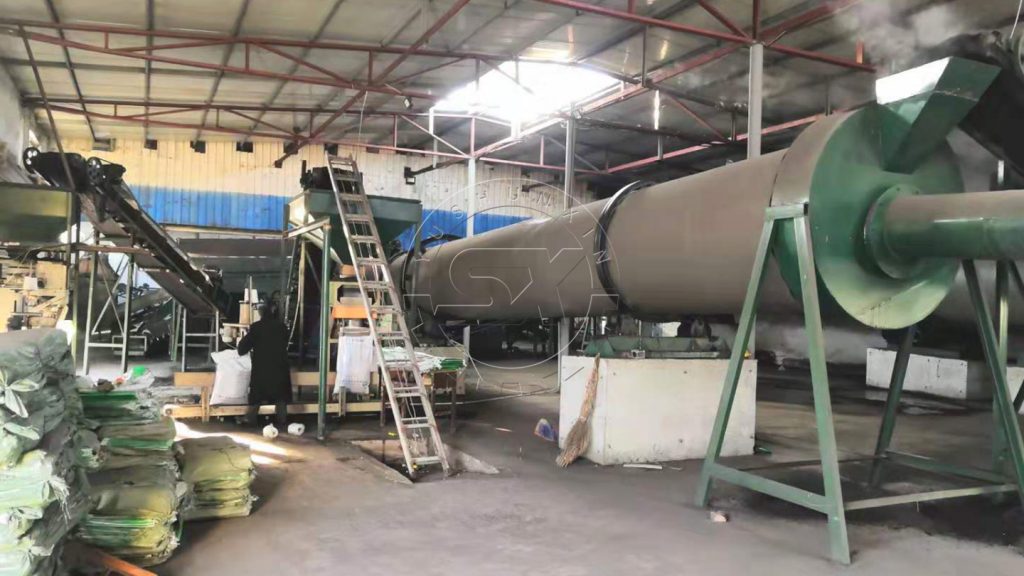
The design of compound fertilizer production line
3 t/h compound fertilizer production line

The Blending Technique For Producing Granules

Blending every one of these materials together can either be completed manually, or it might involve an even more complex process. A lot of the production systems today are controlled by computers. This may cause the combination in the different nutrients very exact. Whether this can be a large-scale system, or one built to produce just a few a lot of fertilizer annually, you will need a space to put everything. It must also be arranged, including conveyor belts, which will help inside the production process. The blending method is the procedure for weighing materials that you are used to produce the fertilizer pellets. These will likely then be combined together, rotated, and ultimately processed into compound fertilizer pellets which can be used or store.

In Which The Blending Occurs

This typically occurs on the inside of a rotating drum granulation machine. The rotating cylinder will probably not merely mix the numerous components and definitely will also be involved within the formation of the pellets. This will be a significant element of your compound fertilizer granulation line that could work nearly 24 hours a day. The blending process, given that the measurements are already done efficiently, will cause a highly efficient fertilizer for your personal business. In some instances, you may produce as much is 20 a lot of this product every hour. This is great for large-scale operations, or firms that have multiple properties where several types of crops are grown.

The large-scale plant for compound fertilizer production
The design of compound fertilizer production line

From start to finish, the compound fertilizer production process is very elaborate. It calls for all the components that were mentioned. Having an ample availability of nutrients to use, and the machinery to complete the task, producing 1000s of plenty of this product is extremely easy to accomplish. Should you would prefer not to purchase your compound fertilizer making machines from third-party source, obtaining one of these brilliant systems could be advantageous. While the initial expense is high, they will often buy themselves within a long period, which makes this an intelligent and profitable decision to create.

How You Can Make The Very Best Bentonite Granules

It’s essential to research the way to create bentonite granules. That way, your project which utilizes them will be able to move ahead without an excessive amount of trouble. With all the right equipment, you may make granules of any type of material and it’s not going to help you get too long of any time, either.

You’re going to need bentonite or otherwise a material that turns into it when you process it. That may be something you have to look for a source for that isn’t charging more than exactly what the material should be worth. Generally, you can easily ask around by emailing companies of bentonite granules making machine that handle the type of material you need to get a couple of price quotes to acquire a sense of what this will amount to. If you’re capable to buy in big amounts, you really should do that because which is how you have a lower price on everything.

Disk granulating machine for bentonite fertilizer
Bentonite fertilizer making machine

You require bentonite making machinery that’s going to turns your materials into bentonite granules. The machinery might be one piece depending on what you need or a lot of different machines if you must process the type of material some different ways in order to help it become in to the granules. When it comes to buying machinery, you’re going to need to see if you will find affordable options on the market that make sense along with your budget. You may find machinery options which can be used in order to save even more but test anything used before spending money on it.

Selling your bentonite granules is one thing you should make sure you’re intending to make good money from. You don’t desire to lose money because you’re which makes them and after that not making more than a refund when you sell them. It’s simple to find a buyer that’s will be fair, it’s just a matter of marketing yourself well. Make a advertising campaign that permits you to tell people anything they can get from you when they buy what you must offer. Look into websites of your respective competition if you would like find some good good ideas on how to market yourself.

Rotray drum granulating machine for bentonite fertilizer
Commercial benotinite granulating machine for sale

Realize how to take care of your bentonite granules making machinery thus it can be useful for you for many years. Should you don’t learn how to inspect what you’re utilizing, then you’re likely to would like to work with a mechanic to do frequent inspections. When you get everything considered regularly, you’re going so as to check if there are small issues that ought to be dealt with. Don’t ignore problems after they happen since if you wait too much time they are able to get a whole lot worse then which makes them higher priced to deal with.

Now you can produce bentonite granules without the need to do a lot of research. Many options are out there when it comes to the machinery that you can use. Assist the guidelines above and emerging from this with granules you’ll be happy with might be a reality to suit your needs.

Process Analysis of FPC New Type Organic Fertilizer Extrusion Granulator

Process introduction of inorganic organic fertilizer extrusion granulation production line:

ShunXin roller pressing granulating equipment
  1. Add the qualified raw materials into the mixer according to the ratio requirements and mix them evenly.
  2. Transport to the disc feeder, and remove the ferrous materials from the material during the transportation process.
  3. The material in the disc feeder evenly enters the extrusion granulator.The material is forced to pass between the two pressure rollers to be squeezed into flakes. The flakes are broken into pieces by the coarse crusher under the pressure rollers. Screening; the materials on the screen continue to be crushed and screened.
  4. The semi-finished products are transported to the finished product screening machine; the fine particles after screening are directly returned to the disc feeder,the large particles are crushed by the crusher and then returned to the disc feeder.
  5. The qualified products after screening are transported to the automatic packaging scale for weighing, packaging and storage.
quality part of double roller extrusion granulation machine

The production of compound fertilizer by extrusion granulation process has the following advantages and disadvantages

  1. Extrusion granulation does not require heating and humidification of the materials, which saves investment and energy, and can also be adapted to the granulation of ingredients containing heat-sensitive materials, such as ammonium bicarbonate and certain organic fertilizers.
  2. No waste water or waste gas is discharged outside during the production process, and it will not pollute the environment.
  3. The extrusion granulation process is short, easy to operate, easy to realize automatic production control, and improve production efficiency.
  4. There are no special requirements on the properties and particle size distribution of the raw materials, so the source of raw materials is relatively wide.
  5. The production is more flexible, and the product plan can be changed at any time, which is conducive to the production of special fertilizers in small batches.
  6. The product has uniform particle size distribution, no segregation or agglomeration.
  7. The shape of extrusion granulation products is not as round as the particles produced by traditional methods such as drum granulation and slurry granulation; if chemical reactions occur between the ingredients in the product particles, the particles may collapse.
Double Roller Granulator in Manufacturing

According to the requirements of customers, we can design 10,000-500,000 tons of organic fertilizer production line and workshop design, provide complete sets of organic fertilizer equipment, BB fertilizer production equipment, organic and inorganic fertilizer equipment, liquid fertilizer equipment, urea-based compound fertilizer equipment, extrusion Fertilizer pressing equipment and high-humidity material drying and fermentation equipment such as chicken manure.

How Does the Organic Fertilizer Production Line Make Organic Fertilizer into Pellets?

With the development of environmental protection and organic agriculture, the use of organic wastes to produce organic fertilizers through biological fermentation has been rapidly developed, making the treatment of organic wastes harmless and resourceful. However, most of the organic fertilizer obtained by biological fermentation is coarse powder or irregular small lumps, which is very inconvenient to use, and is particularly unfavorable for large-area machine sowing. Making the coarse powder or irregular small pieces of organic fertilizer obtained by biological fermentation into spherical granular organic fertilizer is the key to solving the problem of large-scale popularization and use of organic fertilizer.

FPC will explain to you how the organic fertilizer production line makes organic fertilizer into pellets. The coarse powder or irregular small pieces of organic fertilizer after biological fermentation are characterized by high water content (30-40%) and looseness ( The bulk density is 0.3~0.4t/m3), and the fiber is much. The existing organic fertilizer in the form of coarse powder or irregular small pieces after biological fermentation is made into spherical granular organic fertilizer.

  • Some manufacturers use traditional discs or drums to granulate, and need to dry coarse powder or irregular small pieces of organic fertilizer (moisture content <15%) and crush them into very fine powder (greater than 100 mesh) . Then add the binder and inorganic fertilizer, and the addition amount of the binder and inorganic fertilizer in the organic fertilizer cannot be greater than 30%. Although this method can be made into spherical particles, the organic fertilizer in the processing process will be crushed by sufficient precipitation, then be granulated by adding water and then dried, repeated many times, so the processing cost is quite high. Moreover, due to the low density of organic fertilizer, the particle strength is low, which is not conducive to storage, transportation, and machine seeding.
disc granulator machine
  • There are also some manufacturers who first dry coarse powder or irregular small pieces of organic fertilizer until the moisture content is only 20-25%. Then, a flat die extrusion granulator or a pair-roll extrusion granulator is used to squeeze the dried organic fertilizer into columnar or oblate spherical particles. Although this method is more convenient to use, the fluidity is still not good, it is not suitable for machine broadcast, and the appearance is poor and the appearance is not good.
ShunXin roller pressing granulating equipment
  • Some manufacturers first use flat die extrusion granulatorto squeeze the coarse powder or irregular small pieces of organic fertilizer into short columnar particles (due to high water content and high fiber content, columnar particles also have a certain degree of plasticity). Then, it is polished to form spherical particles, and then the spherical particles are dried, cooled and sieved to obtain qualified particles. In this method, the raw materials do not need to be processed, the moisture sequence is reduced in steps, and the production cost is greatly reduced. However, this method also has some fatal weaknesses, that is, organic fertilizer is easy to arch, easy to block and easy to bond equipment, and at the same time, the output is small and the power consumption of the extrusion process is high.
Flat die granulator

Therefore, in summary, the organic fertilizer industry urgently needs to introduce a large-yield, low-energy compression granulating equipment to overcome the easy arching, easy blocking, easy bonding equipment, and small output of the traditional granulator. And the shortcomings of high power consumption in the extrusion process.

Working Principle and Advantages of Disk Fertilizer Granulator

  • How does the Disc Granulating Equipment Work?

The material and binder can be thoroughly mixed before entering the pelletizer. This produces a uniform mixture and uniformly disperses the binder.

Most of the moisture required to form the fertilizer balls can be added during the mixing process (in the form of adhesives), so it does not need to be done in the granulator, which can be a long process. Therefore, in many cases, the use of the mixer prior to the pan pelletizer usually increases productivity.

The pre conditioned material is densified by the motion exerted by the mixer. Because this densification is achieved by mixing, less binder is required to produce the same densification, thereby reducing the cost of the binder.

After conditioning, granulation will continue. For processes that do not use preprocessing steps, this is where the process begins. Here, the material is fed to the pelletizer at a continuous rate, and the binder is continuously added to it. Because of the adhesive, the fine powder of the material is sticky. When the granulating pan rotating, it will pick up more fine powder when it drops by its own weight. Its growth mode is similar to that of snowball.

Once the granules have reached the required size, they leave the pelletizer and are transported to the drying equipment by belt conveying machine.


  • Advantages of disc granulating machine:

Its structure is simple and easy to operate and maintain. In particular, since the fertilizer balls in the granulating disc can be directly seen, the replacement and adjustment are convenient and quick.

Low price, small installation area. At the same output, the price of the disc granulator in ShunXin Machinery is two-thirds, and the installation area required is about half of that of other kinds of fertilizer granulators.

It has classification effect. When the required granularity is reached, it will automatically eject from the edge of the disc. The particle size of the product is relatively uniform.

The product has high particle strength and good quality. Due to the gradual increase of pellets in rolling and falling process, it is not easy to be crushed and has smooth surface.