Large livestock farms and fertilizer manufacturers are increasingly looking for ways to increase the value of processed manure. After composting, cow manure becomes a stable organic material that can be further processed into marketable fertilizer products. A complete cow manure granules production project requires suitable crushing, mixing, granulating, drying, screening, and packaging equipment to achieve continuous commercial production.
For investors planning a new fertilizer factory, selecting the right machinery is essential because the final granule quality, production capacity, and operating cost depend on the complete process design.
Why Invest in Large-Scale Cow Manure Fertilizer Production?
A commercial cow manure fertilizer plant allows farms and fertilizer companies to convert finished compost into higher-value organic fertilizer granules. Compared with selling loose compost, granulated fertilizer is easier to store, transport, package, and sell through agricultural channels.
Large-scale production also helps improve resource utilization. By combining mature composting technology with automatic processing equipment, operators can create a stable fertilizer supply while reducing waste management pressure.
What Equipment Is Needed After Cow Manure Composting?
When composted cow manure is ready for granulation, the material usually needs further preparation before entering the production line. The main equipment includes:
1. Crushing Equipment
Even well-fermented compost may contain lumps or uneven particles. A crusher is used to break large pieces into a more uniform size, which improves mixing efficiency and helps produce consistent fertilizer granules.
2. Mixing Equipment
A mixer combines composted manure with additives, minerals, or other organic materials according to the required fertilizer formula. Uniform mixing ensures that each granule contains balanced nutrients.
3. Granulation Equipment
The core of the production line is the granulator. The selection depends on production capacity, raw material characteristics, and the required granule shape. Different projects may use disc granulators, rotary drum granulators, or new-type organic fertilizer granulators.
The equipment for granulating composted cow manure should provide stable operation, suitable moisture adaptation, and reliable granule formation for long-term production. learn more.
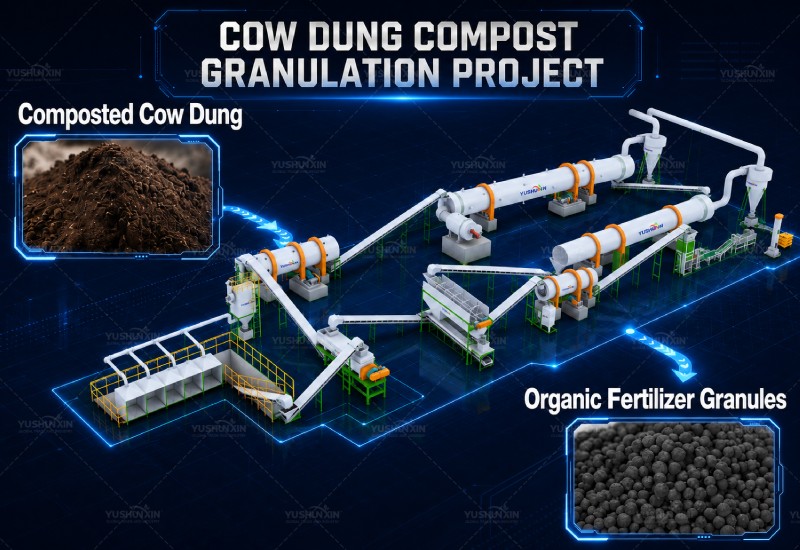
How Does the Composted Cow Manure Pellet Production Process Work?
The composted cow manure pellet production process normally includes several continuous stages: crushing, batching, mixing, granulation, drying, cooling, screening, and packaging.
After granulation, drying equipment reduces moisture content to improve storage stability. Screening equipment separates qualified granules from oversized or undersized materials, while the returned material can be recycled back into production.
For large fertilizer factories, automatic control systems can also be added to improve production efficiency and reduce manual operation requirements.
Complete Equipment Planning for Commercial Projects
A successful cow manure granulation project is not only about purchasing individual machines. The production line layout, capacity matching, workshop conditions, and future expansion plans are equally important.
For example, a medium or large factory may require automatic feeding systems, belt conveyors, dust collection equipment, packing machines, and electrical control systems. A complete engineering design helps ensure smooth material flow and stable operation.
A professional supplier can provide a turnkey cow manure granulation solution for Argentina, including process design, equipment configuration, manufacturing, installation guidance, and technical support.
Conclusion
Building a large-scale cow manure fertilizer production facility requires careful equipment selection and process planning. With the right crushing, mixing, granulation, drying, and packaging systems, composted cow manure can be transformed into high-quality organic fertilizer granules with strong market value.
Investors should focus on production capacity, raw material conditions, and long-term operation reliability when choosing a complete granulation solution. Here, you can visit https://www.granulatedcompostsolutions.com/product/cow-dung-composting-granule-making/ for solutions.