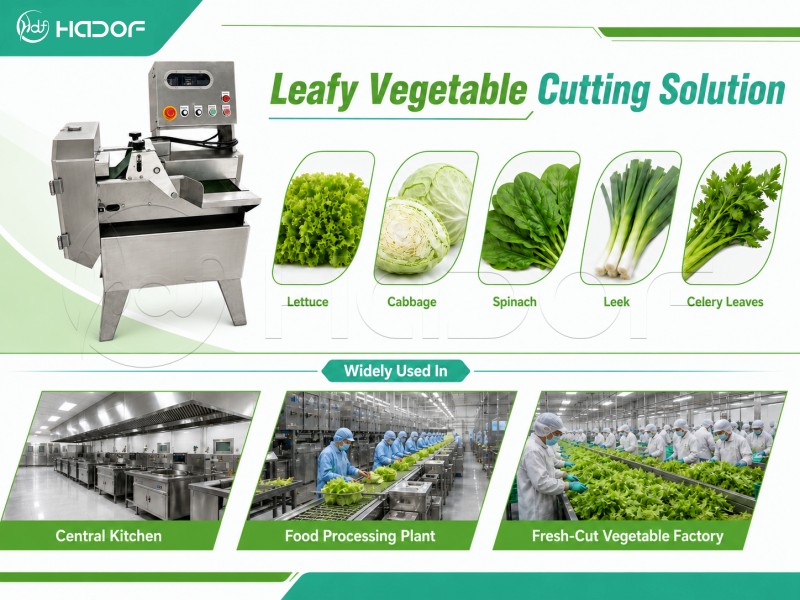
A central kitchen usually handles large daily volumes of lettuce, cabbage, spinach, celery, leeks, and other fresh vegetables. Therefore, a buyer should compare labor requirements, cutting consistency, sanitation, floor space, and food production cost before selecting equipment. An automatic leafy vegetable cutting machine for central kitchen can support repetitive slicing and chopping when your kitchen requires stable output throughout several production shifts. However, a manual vegetable cutting station still offers useful flexibility when workers need to inspect, trim, or classify irregular raw materials.
How Much Food Preparation Capacity Does a Central Kitchen Actually Need?
A central kitchen should first calculate its hourly food preparation demand instead of comparing equipment only by purchase price.
Model 802 handles approximately 300–800 kg of vegetables per hour, while Model 803 handles about 200–500 kg per hour. Both models use a 1.1 kW drive system. Therefore, these machines suit restaurants, catering groups, supermarket preparation centers, meal factories, and fresh-cut vegetable producers that need continuous food processing capacity.
The operator controls conveyor speed and knife speed through the frequency-control system. Consequently, the food production procedure can produce shorter vegetable pieces for fillings or longer pieces for salad and cooked dishes. The equipment supports cutting lengths of approximately 1–40 mm, so one machine can handle several food manufacturing specifications.
Manual processing follows a different production logic. Workers can adapt quickly when vegetables vary significantly in size or shape. However, manual food preparation capacity changes with worker skill, fatigue, shift length, and staffing availability. Therefore, an automatic cutting machine usually gives a central kitchen more predictable food production planning when one product specification accounts for most daily output.
Which Raw Materials Need Automatic Cutting and Which Materials Still Need Manual Handling?
A central kitchen often processes several raw-material groups during one shift.
The automatic cutter suits lettuce, Chinese cabbage, spinach, celery leaves, leeks, green onions, herbs, long beans, and similar products. These leaf vegetables used in commercial meal preparation usually require repeated segment cutting, shredding, or chopping before mixing, cooking, packaging, or meal assembly.
However, some raw materials require visual inspection before automatic processing. Workers often need to remove damaged leaves, roots, discolored sections, foreign materials, or irregular pieces before the cutting process.
A six-station manual vegetable trimming and sorting table therefore works well before an automatic cutter. The table allows several operators to complete vegetable inspection, trimming, waste disposal, and food handling management at the same time. Hadof also offers 2-, 4-, 6-, and 8-station structures for different factory layouts and labor plans.
This combined production technique suits lettuce, cabbage, broccoli, carrots, potatoes, onions, sweet potatoes, and mixed fresh produce. Consequently, a central kitchen does not always need to choose one technology and reject the other.
How Do Machine Price, Labor Cost, and Food Production Investment Affect the Decision?
A buyer should evaluate total food production investment instead of examining only the equipment price.
The current product range includes compact models for different capacity requirements. Therefore, a leafy vegetable cutting machine price and capacity guide for food factories helps a procurement team compare hourly output, machine dimensions, conveyor width, power demand, and available workshop space before requesting a quotation.
An automatic food cutting machine can reduce repetitive manual cutting work. Moreover, consistent machine speed can help a kitchen maintain similar vegetable dimensions between production batches. This consistency supports portion management, packaging weight control, cooking preparation, and downstream food manufacturing.
A manual system requires more operators, but it gives workers greater flexibility for raw-material inspection and irregular trimming. Therefore, labor cost alone should not determine the purchase decision.
A procurement team should also calculate cleaning time, knife replacement, operator training, available electricity, production shifts, spare parts, and future capacity growth. These factors create a more realistic food processing equipment budget.
Which Vegetable Cutting System Fits a Central Kitchen Expansion Plan?
A growing central kitchen usually gains the best result from a hybrid food processing system.
The production line can first use a washing machine for raw-material treatment. Workers can then inspect and trim vegetables on a manual sorting table. After that, the automatic leafy vegetable cutter can complete standardized slicing or chopping. Finally, conveyors, dewatering machinery, mixers, cooking equipment, or packaging machines can continue the food preparation process.
This system separates judgment-based work from repetitive cutting work. Therefore, workers can focus on quality inspection while the machine controls cutting speed and product dimensions.
A buyer who plans future expansion can also review Hadof food processing machinery solutions for central kitchens when the project requires washing, cutting, dewatering, conveying, frying, drying, freezing, or packaging equipment.
The final choice should match raw materials, hourly output, cut size, labor availability, factory area, and investment budget. A small central kitchen with many irregular products may still depend heavily on manual preparation. In contrast, a large catering or fresh-cut food factory usually gains more production stability from automatic cutting technology. A combined manual inspection and automatic cutting system often provides the strongest balance between flexibility, food handling control, labor management, and scalable food production. You can visit: https://www.hadofps.com/products/leafy-vegetable-cutting-machine/